PU vs PVC Leather: What's the Difference?
PU leather is softer, more breathable, and generally more eco-friendly, while PVC leather is more durable, waterproof, and less expensive — the right choice depends on the application.
Published 2026-08-29
PU leather is softer, more breathable, and generally regarded as more eco-friendly, while PVC leather is typically more durable, more waterproof, and less expensive. The right choice depends on the end application, budget, and required performance characteristics.
PU vs PVC: Side-by-Side Comparison
| PU Leather | PVC Leather | |
|---|---|---|
| Base material | Polyurethane resin coating | Polyvinyl chloride (PVC) coating |
| Feel & flexibility | Softer, more supple, more breathable | Stiffer, less breathable |
| Durability | Good; can degrade faster under heavy abrasion | More resistant to abrasion, water, and weathering |
| Cost | Generally higher | Generally lower |
| Environmental profile | Considered more eco-friendly; water-based PU formulations reduce solvent use | Contains chlorine; harder to recycle, higher environmental concerns |
| Common uses | Fashion, footwear, bags, automotive interiors, furniture | Outdoor furniture, industrial upholstery, marine applications, budget-sensitive goods |
| Global export share (China, 2017–2025) | ~68–74% of combined PU+PVC+other plastic-coated leather exports | ~24–30% |
What the Trade Data Shows
Our analysis of a decade of China customs export data (HS 5903 series) shows that PU leather has consistently outsold PVC leather by a wide margin — but the gap has been narrowing slightly in recent years.
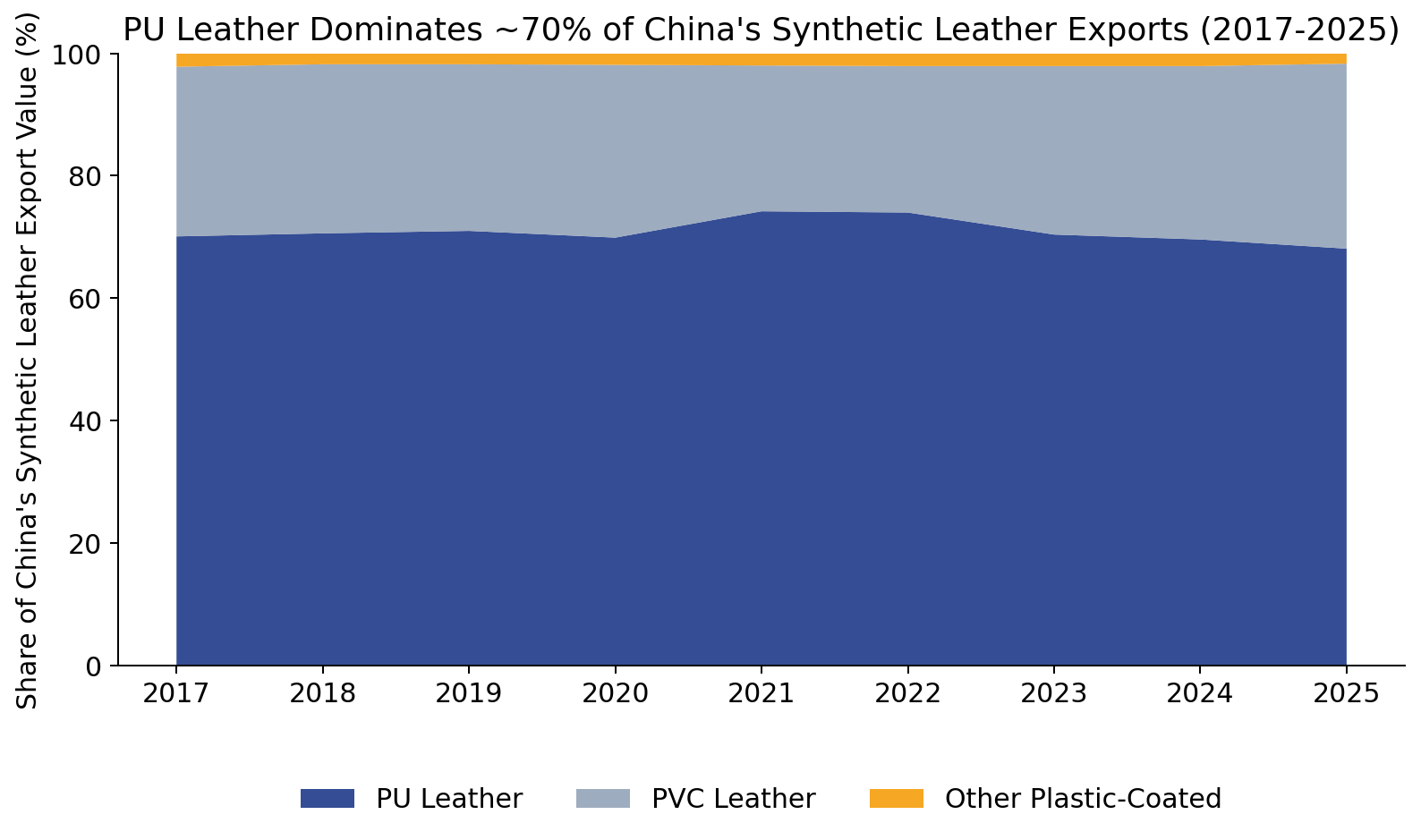
PVC’s share climbed from a low of 23.9% in 2022 to 30.2% in 2025, suggesting a modest shift back toward PVC, likely driven by cost pressure in some end markets.
Unit Price Trends Tell a Related Story
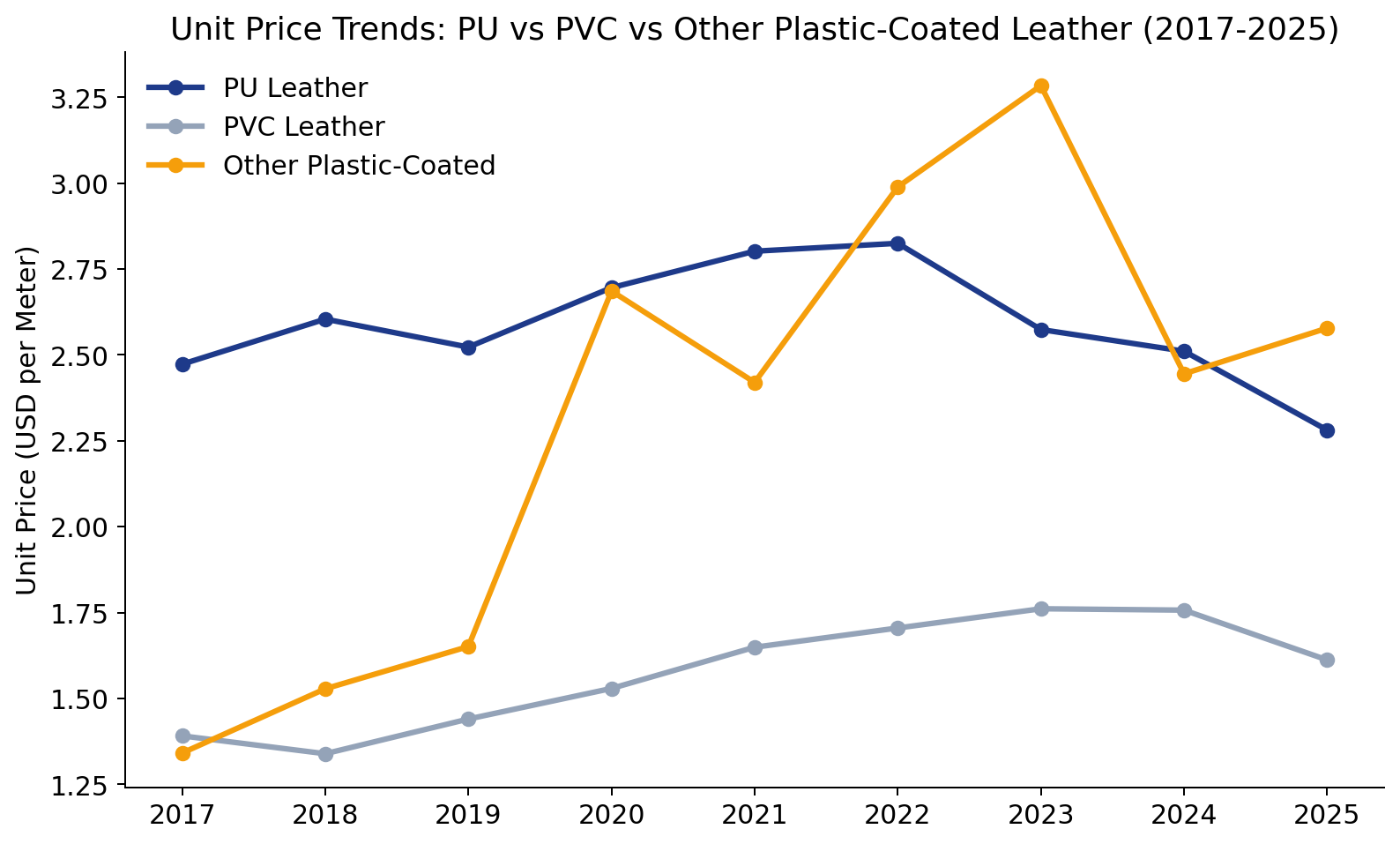
Interestingly, PU leather’s unit price peaked in 2022 ($2.83/meter) and has been declining
since, while PVC leather’s price peaked a full year later, in 2023 ($1.76/meter) — suggesting
some buyers shifted toward PVC as PU prices rose, before PVC’s own price cycle caught up.
Buyer Preferences Differ by Country
PVC leather is disproportionately popular in the United States and Nigeria compared to PU — the U.S. ranks #3 among PVC export destinations but only #7 for PU, and Nigeria ranks #4 for PVC but doesn’t appear in PU’s top 15 destinations at all. This suggests these markets place higher value on PVC’s durability and lower cost for applications like outdoor and industrial upholstery.
Which Should You Choose?
- Choose PU leather for fashion goods, footwear, bags, automotive interiors, and furniture where softness, breathability, and a premium hand-feel matter most.
- Choose PVC leather for outdoor furniture, marine upholstery, industrial applications, or budget-sensitive products where water resistance and abrasion durability are the priority.
Related Reading
Data sources: China General Administration of Customs export statistics (HS 59032020/PU, 59031020/PVC, 59039020/other plastic-coated, 2017–2025H1), independently processed and analyzed.