What is PU Leather? Complete Guide
PU leather (polyurethane leather) is a synthetic material made by coating a fabric or split-leather backing with a layer of polyurethane, designed to mimic the look and feel of genuine leather at a lower cost and with more consistent quality.
Published 2026-08-29
PU leather (polyurethane leather) is a synthetic material made by coating a fabric or split-leather backing with a layer of polyurethane resin. It is manufactured to replicate the appearance, texture, and hand-feel of genuine leather, while offering more consistent quality, lower cost, and a wider range of colors, finishes, and technical properties than natural hides.
How Dominant Is PU Leather in the Global Market?
Based on our analysis of a decade of Chinese customs export data (HS code 5903, covering all plastic-coated synthetic leather), PU leather has consistently accounted for roughly 68%–74% of China’s total synthetic leather export value every year from 2017 through 2025 — more than double the combined share of PVC leather and all other plastic-coated leather materials.
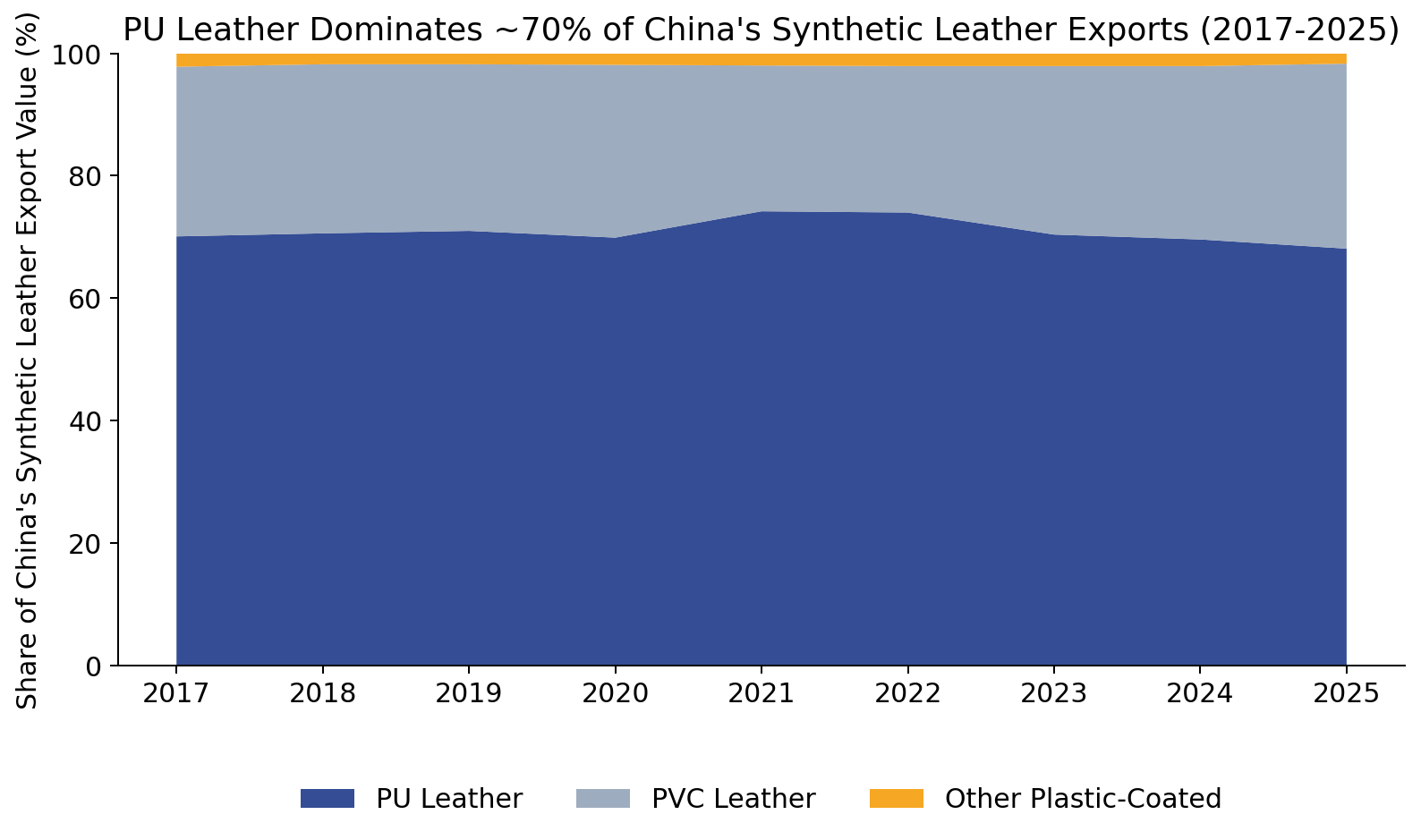
| Year | PU Share | PVC Share | Other Plastic-Coated |
|---|---|---|---|
| 2017 | 70.1% | 27.7% | 2.2% |
| 2020 | 69.9% | 28.2% | 1.9% |
| 2022 | 74.0% (peak) | 23.9% | 2.1% |
| 2024 | 69.6% | 28.3% | 2.1% |
| 2025 | 68.1% | 30.2% | 1.7% |
Source: China customs export data, HS 59032020 (PU), 59031020 (PVC), 59039020 (other plastic-coated), 2017–2025. Full methodology in our trade data analysis.
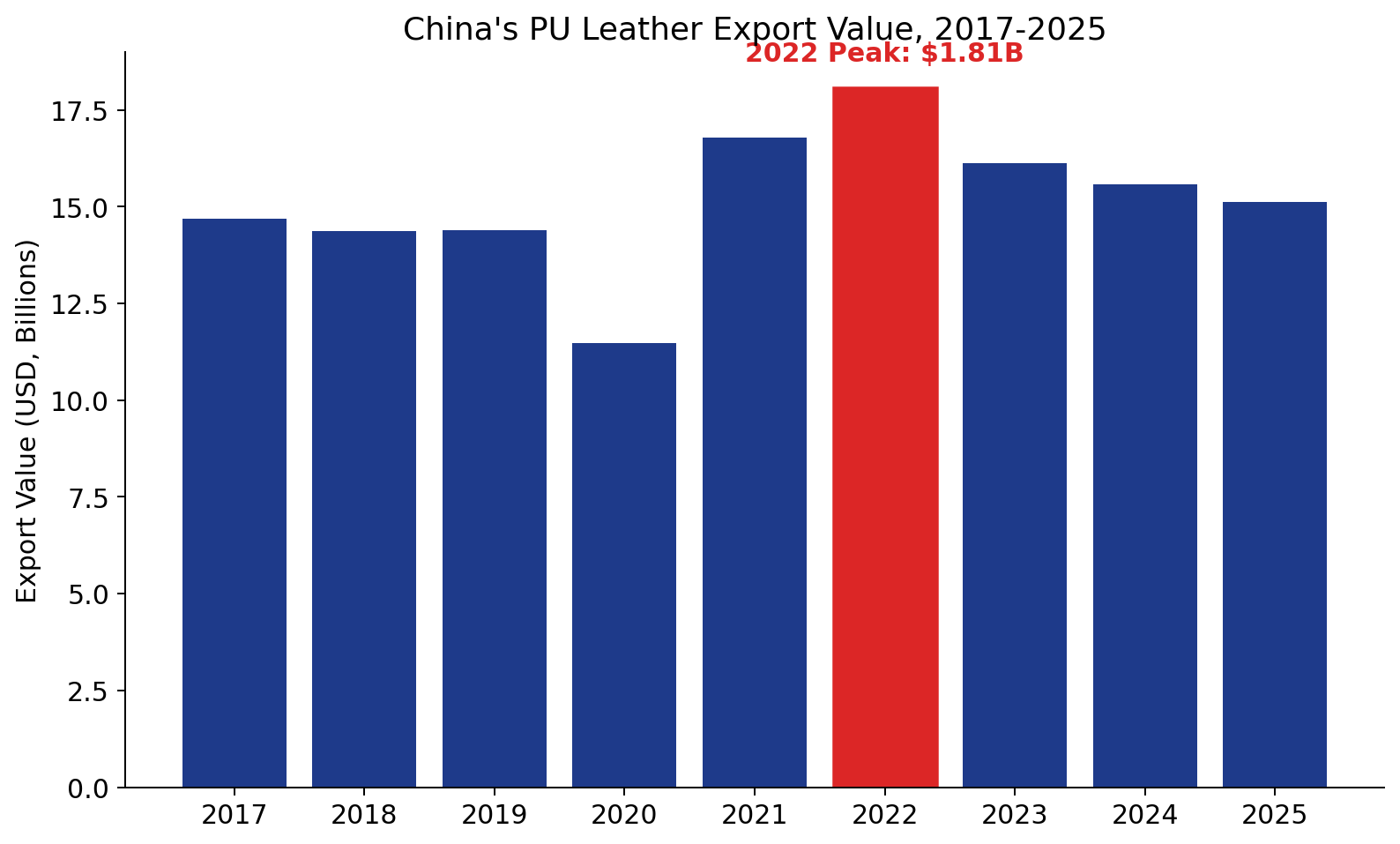
Export value peaked in 2022 at roughly $1.81 billion, driven by post-pandemic demand recovery, before easing back as global buyers diversified sourcing and unit prices corrected.
What Is PU Leather Made Of?
PU leather is a composite material with two main layers:
- Backing fabric — typically a woven, knitted, or non-woven textile (polyester, cotton blends, or specialty non-wovens for microfiber-style products) that provides structural strength and dimensional stability.
- Polyurethane coating — one or more layers of PU resin applied via wet or dry lamination processes, then finished with embossing, printing, buffing, or surface treatments to achieve the desired texture, gloss level, and pattern.
PU Leather: Advantages and Limitations
Advantages
- Consistent color, thickness, and texture across large production runs
- Lower cost than genuine leather at comparable visual quality
- Wider range of finishes: matte, glossy, embossed, metallic, printed patterns
- No natural blemishes, scars, or size limitations of animal hides
- Generally more breathable and softer-handling than PVC leather
Limitations
- Less durable over the long term than full-grain genuine leather in high-abrasion use
- Quality varies significantly by manufacturer and formulation (solvent-based vs. water-based PU)
- Can be less heat- and UV-resistant than PVC in some outdoor/automotive applications, depending on formulation
Common Applications
Based on both our competitor content analysis and real customs trade data, PU leather is most widely used in:
- Automotive interiors (seating, door panels, dashboards)
- Footwear (uppers, linings)
- Bags and handbags
- Furniture and upholstery
- Garments
Top Export Markets for PU Leather
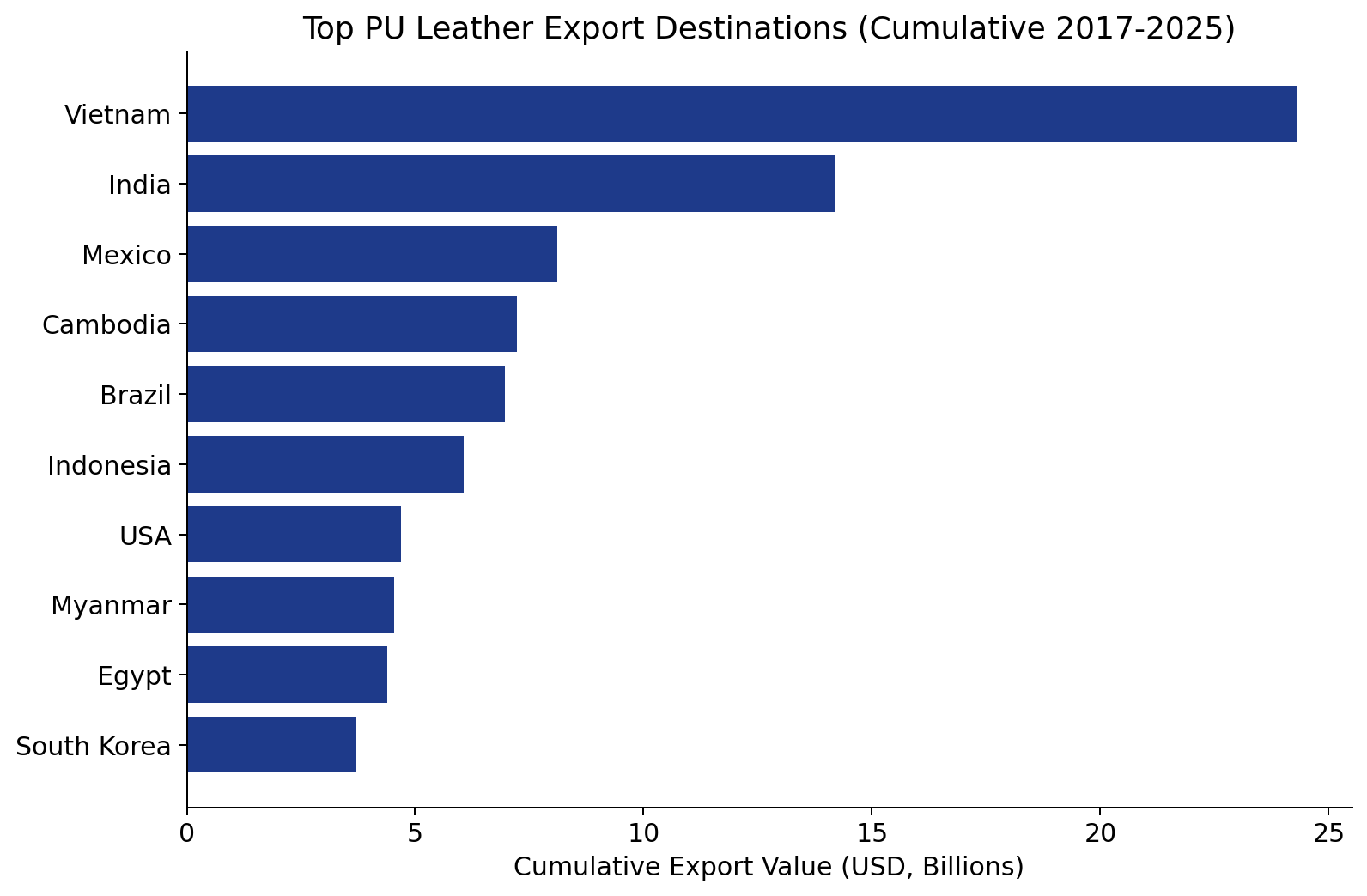
Vietnam, India, Mexico, Cambodia, and Brazil are the largest cumulative buyers of Chinese PU leather by export value — a pattern that closely tracks global footwear/garment manufacturing hubs (Vietnam, Cambodia) and automotive production hubs (Mexico, Brazil).
PU Leather vs. PVC Leather
See our full comparison: PU vs PVC Leather: What’s the Difference?
PU leather is the most common material behind the umbrella term “faux leather” — see our complete faux leather guide for how the two terms relate.
Not the Only Type of Synthetic Leather
PU is the most common resin, but it’s one of several. See our complete classification guide for how PU compares to PVC, TPU, silicone, and bio-based alternatives — including the ester-vs-ether PU distinction that determines how long PU leather actually lasts in humid climates. And if you’ve ever wondered whether “pleather,” “artificial leather,” and “PU leather” are the same thing, see our terminology guide.
Data sources: China General Administration of Customs export statistics (HS 5903 series, 2017–2025H1), processed and analyzed independently. All figures represent original research — see our full trade data methodology for details.